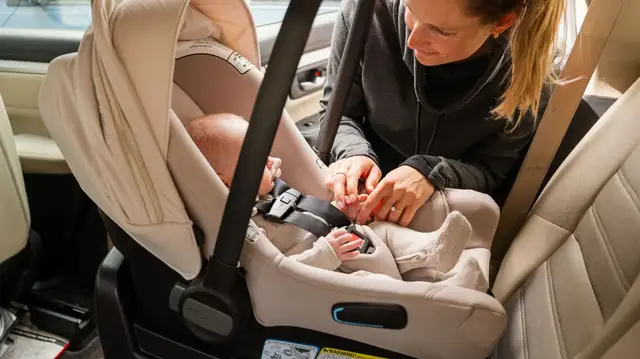
Overview
The Nuna PIPA aire offers a relatively light carrier within Nuna's infant-seat range. BabyGearLab's September 2026 review reports a measured carrier weight of 7.1 pounds and favourable results in its commissioned crash testing. Its practical observations also show why low weight should be considered alongside installation and daily adjustment.
Make the weight comparison consistent
Carrier weight matters most when the infant seat will regularly be carried away from the vehicle. Compare complete configurations with the canopy, inserts and other approved components that will actually be used. A manufacturer's minimum-weight figure and a reviewer's measurement may describe different setups.
Also try the handle and canopy together. BabyGearLab reports contact between them during some movements and finds the handle's shape less comfortable than rounder alternatives. A small weight saving may be less useful if the grip does not suit the person carrying it.
Investigate the specific base and method
The reviewed base uses rigid lower-anchor connectors, a load leg and a two-position recline arrangement. The source describes the connectors as straightforward but notes that the recline adjustment is easier to make before the base is attached.
The article gives conflicting descriptions of vehicle-belt installation, calling it challenging in some passages and relatively easy in another. That inconsistency should remain an open question rather than becoming a confident recommendation. Obtain the current instructions for the exact PIPA aire bundle and test the intended installation method in the actual vehicle.
Plan for harness-height changes
The reviewed carrier uses a rethread harness with three shoulder-height positions. Moving between them requires a deliberate adjustment, unlike a headrest-linked system. Check fit regularly and follow the current manual's routing instructions when the child needs another position.
The source found everyday tightening smooth but describes buckle padding that could get in the way. It also identifies a carrier-release control on the reviewed base rather than in the more familiar position on the carrier. Practise lifting and releasing the seat as a complete sequence.
Confirm the wider travel system
BabyGearLab describes compatibility with Nuna strollers and selected other brands through appropriate adapters. That is a reason to investigate exact model combinations, not permission to assume that every stroller within a brand will fit. The reviewed carrier can also be installed without the base using approved belt methods; the manual remains essential.
The PIPA aire may suit a family that regularly carries the infant seat and finds its approved installation straightforward. OwnBoy has not tested the carrier, and the source's crash-test results should not be presented as a guarantee for every real-world collision.
Community comments
Be the first to share a useful experience or question.
Share your experience
Contributions are reviewed before publication. Do not share children's personal information.