
Overview
A well-chosen car seat still needs the harness adjusted to the child who is using it. The Car Seat Lady's buckling guide separates several issues that are often confused: harness height, strap tension, routing, padding and the difference between rear-facing and forward-facing use. Checking them in a consistent order makes everyday use easier to explain to another caregiver.
Start with the correct mode and height
Confirm that the child is within the requirements for the chosen mode. For typical rear-facing harness arrangements, the shoulder straps emerge at or below the shoulders; for typical forward-facing arrangements, they emerge at or above them. Use the exact seat's instructions to select the permitted position and to check any model-specific requirements. A visible headrest setting is not, by itself, proof that the harness is correctly placed.
Growth changes this relationship. Look at where the straps actually emerge relative to the shoulders, rather than waiting for a birthday or assuming last month's setting is still suitable. Seats with a headrest-linked adjuster and seats with manually rethreaded straps need different adjustment procedures, but both need the final position checked.
Keep the harness path clear
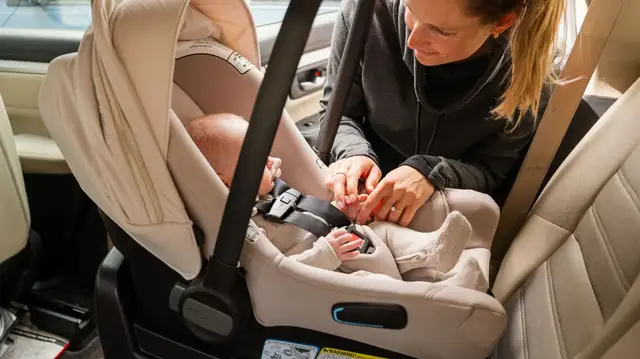
Lay the straps flat and fasten the required buckle components before checking tension. Follow the manufacturer's snugness check; extra slack is not an appropriate way to make a restrained child more comfortable. A twisted strap, incorrectly connected harness end or misplaced buckle component needs correction before travel, even if the visible part of the harness looks neat.
Use infant inserts, strap covers and other padding only as permitted for that exact seat. An insert may have a required size range or a removal point. Adding a separate cushion because it appears supportive can change how the child sits and how the harness fits. Keep the original instructions available when a caregiver needs to check which components should currently be present.
Make the handoff practical
Demonstrate the full sequence while parked: positioning the child, locating the correct straps, fastening the harness and checking its adjustment. Ask the other caregiver to repeat it. After cleaning or changing harness height, inspect the routing again. A short, model-specific routine is more useful than a general reminder to buckle up, particularly when grandparents, childcare providers or a second household use the same seat.



Community comments
Be the first to share a useful experience or question.
Share your experience
Contributions are reviewed before publication. Do not share children's personal information.