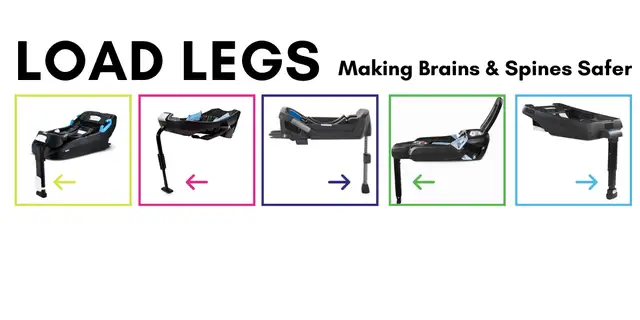
Overview
A load leg extends from a car-seat base or restraint toward the vehicle floor. It is also called a support leg or foot prop. The Car Seat Lady explains it as a feature intended to manage restraint movement during a crash. For a buyer, that purpose needs to be connected with a practical question: can the leg be used correctly in the seating position you plan to use?
Look beyond the feature list
A product photograph cannot show the floor beneath your vehicle's seat. Inspect the intended position for raised sections, storage-compartment lids and other features that may affect where the leg rests. Check the restraint instructions and the vehicle manual together. A flat-looking panel is not necessarily the approved structural surface for a support leg.
The leg's adjustment range also matters. It must reach the permitted contact point in the way the manufacturer specifies, while the restraint maintains its required position and recline. Do not use the leg simply as a jack to force the base into a preferred angle. Follow the exact instructions for contact indicators, adjustment and any allowed configuration differences.
Check each vehicle separately
A base that works in one household car may encounter a floor hump or storage area in another. Compare the intended seating positions rather than assuming all rear seats behave alike. A trial fitting can reveal a compatibility issue that is invisible in a specification table. When the manuals do not settle the question, ask the relevant manufacturers for model-specific guidance.
Do not assume that a load leg can always be folded away when it does not fit. Whether the restraint permits installation without the leg is part of that model's instructions. Similarly, an approved support-leg configuration does not remove the need to use the correct primary attachment method, check recline or fit the harness to the child.
Keep performance claims in context
Demonstrations of one restraint with and without its support leg can explain how that product manages motion. They do not establish a universal score or a measured ranking for every seat with the feature. Compare the complete product, its approved installation options and your vehicle fit. A support feature is useful when it is part of a configuration the family can correctly use every time.



Community comments
Be the first to share a useful experience or question.
Share your experience
Contributions are reviewed before publication. Do not share children's personal information.