Overview
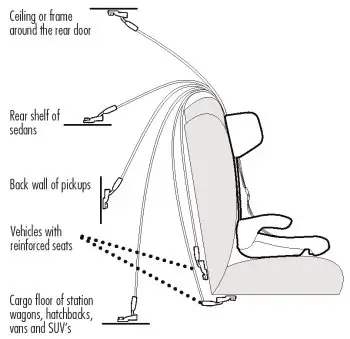
A top tether needs the correct vehicle anchor, not simply a sturdy-looking attachment point behind the child seat. The Car Seat Lady's guide shows that anchors can be located in different places and can be confused with cargo hardware. Start with the seating diagram in the vehicle manual and the tether instructions for the child restraint.
Locate the anchor for that position
Depending on the vehicle, the designated anchor may be on a rear shelf, on the back of a seat, near the floor or in another specified location. A cover or trim panel may conceal it. These examples help explain why a quick visual search is not enough; they do not establish where an anchor must be in your vehicle.
Check each planned seating position independently. The presence of several rear seats does not mean every position has the same tether provision. This becomes especially relevant when moving a forward-facing restraint into a third row or adding another child seat. Plan around the locations actually shown in the manual rather than around whichever seating arrangement looks most spacious.
Follow the complete routing instruction
The route from the child seat to the anchor can depend on the vehicle's head restraint and seat design. Some vehicles, including certain pickups, use arrangements that are not obvious from looking at the hardware. Follow the specified route and attachment point rather than choosing the closest loop. Do not share or substitute anchors unless the relevant instructions explicitly permit that configuration.
The tether is a separate part of the installation from the lower anchors or seat belt. For a forward-facing seat, check the tether requirements even when the main installation uses the vehicle belt. Identify and tighten the tether as directed, then complete the rest of the restraint's installation checks. A secure-looking base does not establish that the top attachment has been handled correctly.
Resolve uncertainty before changing seats
If the manual is missing or the anchor is unclear, obtain the correct vehicle instructions or contact the manufacturer. Ask a qualified child-passenger-safety technician to review a difficult layout. Do not install an improvised eye bolt or convert a cargo hook into a tether point. A vehicle-specific seating map makes future transfers easier and gives every caregiver the same reference.

Community comments
Be the first to share a useful experience or question.
Share your experience
Contributions are reviewed before publication. Do not share children's personal information.