Overview
A secondhand car seat can look almost new while its important history remains unknown. The Car Seat Lady's used-seat guide focuses on that gap between appearance and evidence. Start by identifying who has owned and used the seat, then verify the product itself. A bargain price or a reassuring photograph cannot answer questions about earlier damage or missing components.
Ask about the complete history
Find out whether the seat has been involved in a crash, including when no child was sitting in it. The relevant manufacturer instructions determine whether continued use after a particular crash is allowed. Do not apply a general minor-crash rule without checking that the seat's manufacturer permits it. If the history cannot be established, the uncertainty remains even when no damage is visible.
Ask whether the seat has been altered, cleaned contrary to its instructions or fitted with replacement parts. A seller who received it from someone else may not be able to answer for its earlier use. This is why a known ownership chain is more useful than simply asking whether the current owner believes the seat is fine.
Verify the exact seat
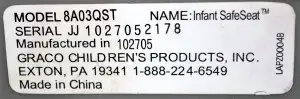
Locate the model identification and manufacturing information on the restraint, then obtain the corresponding manual. Check its stated service-life or expiration requirements; do not assume every seat lasts the same number of years. Dates printed on a fabric tag or a revised instruction label are not necessarily the restraint's manufacturing date.
Compare the parts against the manual, including any components needed for the child's current stage. Look for damage to the shell, harness, buckle and other relevant pieces. Ask the manufacturer about an unclear or missing part rather than substituting a generic component. Check recall information against the exact model and production details, and confirm any required remedy has been completed.
Assess the remaining practical value
Consider whether the seat's permitted remaining life and fit range match the child's expected use. A low purchase price is less attractive if a replacement will be needed shortly. Keep the verified information with the seat when it changes households. If the restraint cannot be used, follow an appropriate local disposal or recycling process that prevents it from being mistaken for a usable donation. A responsible transfer includes the evidence, not just the equipment.
Community comments
Be the first to share a useful experience or question.
Share your experience
Contributions are reviewed before publication. Do not share children's personal information.