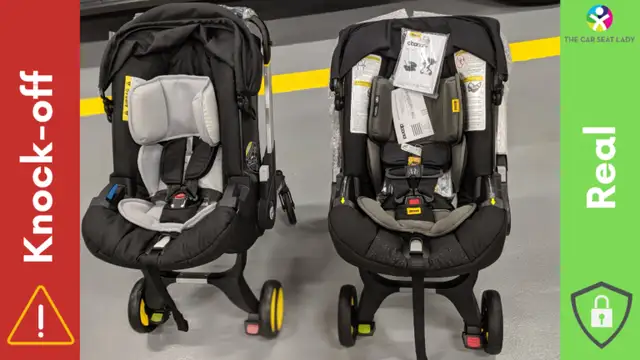
Overview
A familiar shape or logo is not enough to establish that a car seat is genuine. The Car Seat Lady's counterfeit-product guide describes both copies of recognizable seats and vaguely named fabric restraints promoted as travel solutions. The useful buying principle is traceability: the seller, exact model, physical labels and manufacturer support should form a consistent chain.
Identify who is actually selling the seat
On a marketplace, the platform name and the individual seller are separate facts. Read the sold-by information and check whether the manufacturer recognizes that seller as an authorized retailer. Keep the order record and the listing details. A low price can justify asking more questions, but it does not independently prove that a product is counterfeit; genuine clearance and suspicious listings can both be inexpensive.
Find the model on the manufacturer's own current information for your intended market. Similar names can refer to different regional versions, and a product sold legitimately in one country is not automatically suitable for another. Confirm the actual model designation rather than accepting broad phrases such as universal safety seat or portable child harness.
Compare the delivered product with its identity
Look for the manufacturer and model details, manufacturing information, relevant labels and the correct instructions. Check that the registration process and customer-service contact lead to the actual manufacturer. If something is missing or inconsistent, send clear photographs of the labels and the whole product to the manufacturer before putting the seat into use.
Do not use one visual feature as a universal authenticity test. Chest clips, belt routing and labels differ across markets and product designs. Equally, a copied logo or convincing packaging does not establish that the underlying restraint is genuine. A model-specific response from the manufacturer is more useful than comparing a few photographs with a social-media advertisement.
Treat uncertainty as a purchase problem to resolve
Keep packaging and transaction records while you investigate. Ask the seller for a remedy through the purchasing channel when the model or supply chain cannot be verified. Avoid passing a questionable seat to another family. After authenticity is established, the normal checks still remain: recall status, service life, child fit, vehicle compatibility and correct installation. Authenticity is the start of a suitable purchase, not a substitute for those checks.
Community comments
Be the first to share a useful experience or question.
Share your experience
Contributions are reviewed before publication. Do not share children's personal information.